Campaign Against Arms Trade’s new report – Dead Letter – How the UK government’s arms export policies have eviscerated international humanitarian law – exposes how the UK arms exports system is fundamentally broken and rigged in favour of pre-determined conclusions.
The report focuses on two cases – the Saudi-led bombing of Yemen from 2015-2022, and Israel’s ongoing genocide in Gaza. Both cases highlight how successive governments have taken extraordinary measures to circumvent both their obligations under domestic arms export licensing criteria and international law, despite legal challenges and overwhelming evidence of the clear risk that British-made military equipment is being used to commit war crimes that have killed thousands of civilians.
The report’s launch coincides with the government admitting that its new double-lock on arms sales to Israel will not result in the suspension of any further licenses. It also coincides with Andy Burnham’s announcement that Britain is aiding Saudi Arabia in its fresh wave of airstrikes against Yemen. It is therefore clear that there is no intention from the new Labour government to change its approach to facilitating the atrocities carried out by both the Saudi and Israeli governments.
Saudi Arabia
Saudi Arabia is one of the UK’s most important arms customers, with the UK licensing £7.1bn of military equipment between the start of the war in 2015 and the ceasefire in 2022. BAE Systems is the prime contractor, and figures from its annual reports show that between 2007-2025, it received £49 billion in revenue from its deals with the Saudi regime. As the report details, this is a strategic relationship that forms a core part of BAE Systems’ business model. There are no signs of this changing. Newly released data shows that the British government approved £464.8 million of weapons exports to Saudi Arabia in the first quarter of this year. The vast majority of this figure is made up of air-to-surface weapons, raising concerns over their use in Saudi airstrikes.
The Saud-led bombing of Yemen that started on 25th March 2015 aimed to end Houthi control of Yemen. It failed, and instead caused enormous suffering to Yemeni civilians. According to the Yemen Data Centre, the Saudi coalition carried out over 25,000 airstrikes up to the ceasefire on 1st April 2022, killing almost 9,000 people in directly targeted civilian attacks. Air strikes hit residential areas, hospitals, schools, mosques, weddings, funerals and key infrastructure. Combined with a land, air, and maritime blockade, this led to what the UN described at the time as the world’s worst humanitarian crisis resulting in 2.3 million children under 5 suffering acute malnutrition at the beginning of 2022. The UN estimates that the Saudi led coalition killed 377,000 through direct or indirect causes.
Israel
At the time the report was written, Israel had killed at least 73,789 Palestinian people in its genocidal attacks on Gaza. Over 20,000 of those killed were children. The number of people who have died as an indirect result of Israel’s air and ground assaults, and the near-total Israeli blockade of Gaza that has prevented the vast majority of needed aid from reaching Palestinian pepole, is not yet known but is likely to run to the hundreds of thousands. This includes deaths from hunger and malnutrition, disease, and the lack of proper medical treatment due to the widespread Israeli destruction of Gaza’s health care sector (including the killing of large numbers of medical personnel), and the blocking of medical supplies from entering the Strip.
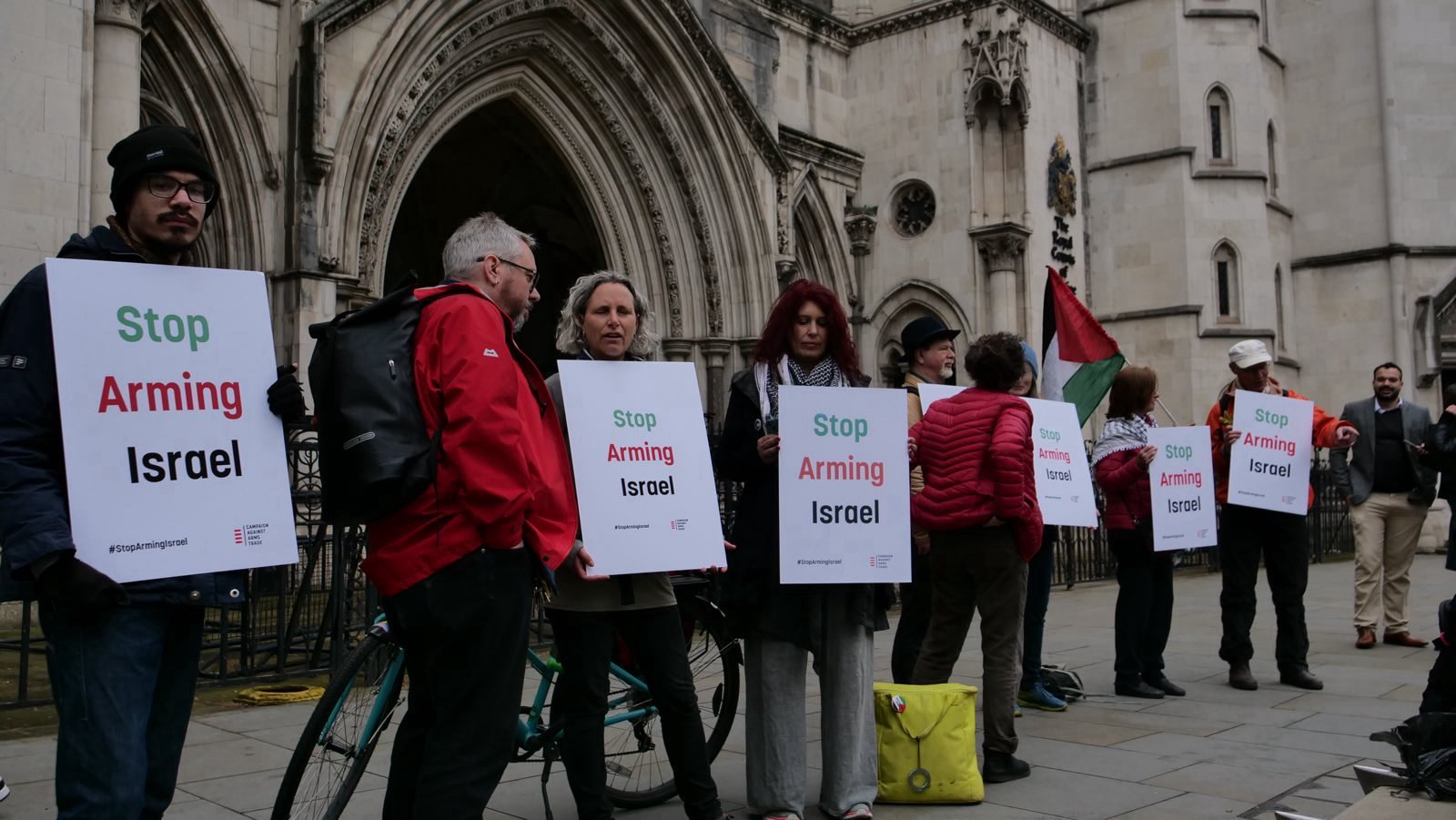
In January 2024, the International Court of Justice ruled that there was a “plausible” risk that Israel was committing genocide in Gaza, In June 2024, the government’s own Export Control Joint Unit came to the devastating finding that “it is uncontentious that conduct which could, in principle, satisfy the physical component of genocide continues to take place in Gaza”. Despite this, successive governments have ignored their own licensing criteria to ride roughshod over both the Genocide Convention and international law. Even when Keir Starmer’s government suspended some licenses to Israel, the exemption made for components for the F-35 combat aircraft – the most lucrative part of the UK’s arms trade with Israel – made the suspension almost meaningless, and meant the UK remained complicit in Israel’s genocide.
While the report does outline recommendations for government, it recognises that they seem superfluous in the face of successive governments wilful blindness and indifference to the impact of their arms sales and international law. Ultimately it concludes that only a radical uprooting of the systems of power and interest that underlie it can bring about real change.
Report author, Katie Fallon, CAAT’s Advocacy Manager, said:
“The structure and systems which have allowed UK arms exports to be complicit in the most grave of international crimes have been developed over decades. This report provides one document for parliamentarians, civil servants, activists, journalists and advocates to understand how we reached a point where senior UK ministers, including prime ministers, refused to stop arming genocide and war crimes, and refused to call for an end to military attacks that blatantly violated international humanitarian law.
“No one can say they didn’t know. A just and peaceful future is only possible if we reckon with the stark reality of our contribution to these crimes and the vested interests they support.”
Report author, Sam Perlo-Freeman, CAAT’s Research Co-ordinator said:
“International law is designed to protect us all. Yet as this damning report shows, successive governments have done everything in their power to continue aiding and abetting genocide and war crimes with deadly and devastating consequences.
“The new so-called ‘double-lock’ on arms exports to Israel exemplifies this. It nothing more than a soundbite designed to appease voters, whilst failing to deliver meaningful policy change, and continuing to allow arms dealers to profit from Israel’s genocide in Gaza.
“Our arms export system is broken beyond repair with criteria and provisions designed to uphold international law rendered meaningless by successive government decisions. If we ever want to see a just and peaceful world, then we need to rip this broken system apart and remove the power and influence arms companies exert on government policy.”