International solidarity statement on UK state repression – taking action to prevent a genocide is not terrorism
On 5 July 2025, the UK government enforced the unprecedented decision to proscribe Palestine Action as a terrorist organisation.
This is a dark time for democracy and a deeply oppressive moment for those of us who take action against the arms trade and against complicity in genocide and mass and structural violence.
Prior to proscription, support for Palestine Action was widespread. It crossed movements, classes, ethnicities, and age groups. Direct action and civil disobedience that directly target the tools of war have a long-standing history in the transnational peace and anti-war movements. People who would not themselves climb on top of an arms factory roof, or attend marches or other campaigning events, have supported those who did. This support did not disappear overnight when hundreds of thousands woke up as potential ‘terrorist’ supporters on the morning of 5th July.
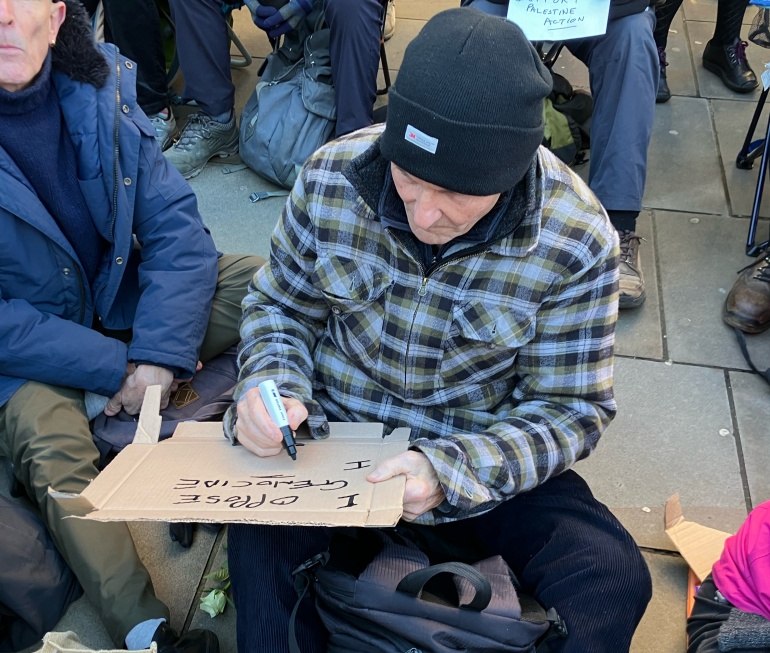
Since the proscription, police have arrested 2710 people holding signs in support of Palestine Action, and Palestine solidarity groups that organise peaceful protests have been threatened with arrest or even had access to their funds cut off indefinitely. In one case, three people were arrested for holding placards saying ‘Oppose Genocide. Ban Starmer not Palestine Action’. During the application for a Judicial Review challenging the proscription, government lawyer James Eadie stated these arrests were “police overreach” and that the placards are “lawful” under the legislative provision permitting campaigning for de-listing.
In the Netherlands, Australia, Belgium and elsewhere, Palestine Action supporters and pro-Palestine activists have been increasingly surveilled, restricted and repressed.
Palestine Action’s proscription also exposes the UK government’s routine instrumentalisation of counter-terrorism laws to persecute marginalised groups and individuals that challenge injustice and violence against civilians in ways that it does not approve—especially in this moment of heightened solidarity with the Palestine liberation movement. In this sense, the proscription starkly exposes this pernicious misuse of counter-terrorism laws against those who ideologically challenge the government by seeking to end arms supplies to a genocide.
The UK government shared in a court hearing that its basis for proscription was that 3 out of almost 400 group actions reached the ‘terrorism’ threshold, and that Palestine Action had sought to influence the government, despite its main target being the arms companies and contractors that supply Israel. This draconian and indiscriminate response to the group’s actions is of course unsurprising given the ever-closer union between the UK government and the arms industry and the many ways in which the arms industry influence is tied-up with government in western arms producing countries.
The far-reaching implications of these developments for our movements – and for the already limited tools at our disposal to challenge potentially illegal arms transfers – cannot be overstated. As organisations and groups that campaign, advocate and litigate against the arms trade, we will not stay silent while our governments are continuing to supply arms to Israel (such as parts for F-35 jets via the global programme)–especially when the legal pathways – through which the government claims we should be able to challenge transfers that clearly violate international law – are failing us. In many cases, governments have themselves admitted that there is a ‘clear risk’ that Israel will use them to commit serious international law violations, including war crimes and crimes against humanity, and that it is unequivocally clear that Israel is unwilling to comply with international law.
Our governments are failing us. They manipulate to their benefit the application of arms trade regulatory frameworks at the international, regional and domestic levels. Instead of taking the only moral and law-compliant option available to them—the imposition of a full two-way arms embargo—they continue to supply arms to Israel.
The UK government’s latest move to criminalise as ‘terrorists’ groups and individuals doing what they feel is necessary to stop an unfolding genocide, is the most repressive and dangerous response so far. It paves the way for other governments to do the same and gives governments and courts a green-light to dismiss legal challenges against the arms trade.
So our message is clear.
We denounce governments’ complicity in genocide and mass structural violence, and will continue to strongly condemn and repudiate government actions that enable the arms trade to Israel and other such contexts. While as organisations or individuals, some of us may not be organising, advocating for or taking part in direct action, we are adamant that such actions, as part of our solidarity with the Palestinian people’s freedom and liberation struggle, do not amount to acts of ‘terrorism’, and we will continue to support the legal challenge against proscription.
We will resist the UK government’s repressive actions and will continue demanding that all governments and arms companies immediately impose and comply with a two-way embargo on all arms supplies to Israel.
Signatories:
- Action Sécurité Ethique Républicaines (ASER)
- Alternativa Antimilitarista.MOC/ADNV
- Antimilitaristes-MOC València
- Bretxa Observatori
- Cairo Institute for Human Rights Studies (CIHRS)
- Campaign Against Arms Trade
- Centre Delàs d’Estudis per la Pau
- European Legal Support Center
- Grupo Antimilitarista de Carabanchel
- Internationale der Kriegsdienstgegner*innen (IDK)
- La Bacora Col·lectiu feminista de Catarroja
- Mujeres de Negro contra la Guerra – Madrid
- PAX (the Netherlands)
- Patxanguilles antifeixistes
- Sare Antifaxista (Antifasist Basque Country)
- Shadow World Investigations
- War Resisters’ International
- War Resisters’ League