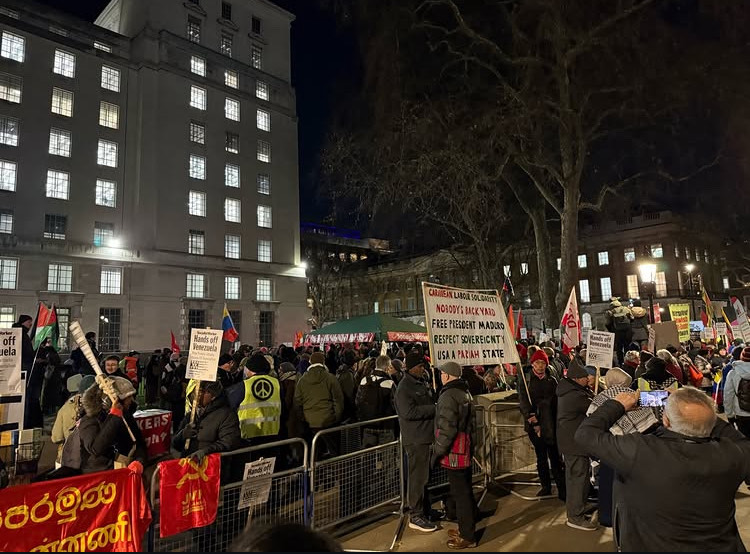
As the United States launches another attack on a nation’s sovereignty, CAAT challenges the myth that there is nothing wrong with exporting weapons to western, democratic countries like the United States. On 3 January 2026, The United States abducted Venezuelan president Nicolás Maduro and first lady Cilia Flores and targeted the country with air strikes, using over 150 aircraft, including F-22 Raptors and F-35 Lightning IIs, killing more than 100 people and injuring a similar number.
The biggest issue with British arms export licences is that the government sells weapons to human rights abusing countries and dictators, right? There’s no issue with exporting arms to western, democratic countries like the United States, right? Western, democratic countries wouldn’t also be abusing human rights domestically and internationally, would they?
CAAT opposes the arms trade in its entirety, which includes arms exports to democratic western countries such as the United States, Canada and countries across Europe. The USA is the UK’s second largest arms customer, having received £4.6 billion worth of limited export licences since 2020, second only to Saudi Arabia, which received £6.4 billion. Of course, Saudi Arabia is closely allied with the United States.
A very high proportion of UK arms are exported to the United States via Open General Export Licences (OGELs), which means that after registering for an OGEL, a company does not need to apply for individual export licences to export many further military goods. Between 2019-23, UK companies won arms contracts worth £8.8 billion for the USA and Canada, the vast majority of which will be for the USA. This is nearly twice the value of the £4.6 billion of approved individual licences, demonstrating how significant the OGELs are.
The United States is the world’s largest military spender and arms producer, and the world’s largest arms exporter, followed by the UK, the second biggest arms exporter in the world. The USA is also Israel’s biggest military backer. Since World War Two, the United States has bombed at least 25 different countries, and been involved in more than a hundred attempts at regime change abroad.
The United States has 877 military bases in 95 countries around the world. No other country comes anywhere near to this number, although the UK has 117 military bases in 38 countries. The UK is also the USA’s closest military ally. There is significant two-way arms trade between the USA and the UK, and ensuingly heavy integration between British and American arms industries.
A Defence Cooperation Treaty between the USA and the UK was signed in 2007, which facilitates arms sales between the two countries with further ease, as this treaty means that specific licences are not needed for most arms exports. Despite this, there were still almost 3000 limited export licences approved from the UK for the USA since 2020, demonstrating the staggering scale of UK to USA arms exports.
CAAT challenges the idea that war and policing are fundamentally different powers. British weapons, technology and security companies export to militaries and police forces around the world. The same repressive exports are used to militarise borders, where the connections between war and policing are further laid bare.
British arms fairs, such as Defence and Security Equipment International, Security and Policing, and Farnborough International, are where these profitable business deals are made, as military-grade weapons are sold to police and security forces for use locally and globally. The British security and defence industry is lucrative for those profiting from it, as often the same companies produce weapons and technology to be used for repression domestically and internationally. Companies like BAE Systems, headquartered in the UK, make weapons for war crimes abroad, and also produce technology used by police and security forces at home.
The UK is the fourth largest exporter of security technology internationally, and is also a significant global supplier of other police equipment, including anti-protest equipment and surveillance technology. Riot shields, produced by British company DMS Plastics, have been used against protesters during the Black Lives Matter uprising in the United States. The same harmful equipment and armaments exported from the UK which are used against protesters, are also used more broadly by racist police forces around the world to inflict often lethal violence onto racialised people.
France, Italy and Canada are also all in the top ten list of the UK’s biggest arms customers. In these western, democratic countries, just like in the UK and the US, police and immigration control forces repress local populations, in an overwhelmingly racialised way. Racist, anti-protester police forces are the norm in western, democratic countries.
Amnesty International has raised concerns about Italian police aggression at a national demonstration for Palestine in Rome last year, and the most recent report from the Council of Europe’s European Commission against Racism and Intolerance (ECRI) received many testimonies of racial profiling from the police in Italy. A landmark ruling this year by the European Court of Human Rights (ECRH) deemed that French police had racially profiled a Black man. This follows mass revolts across France in 2023 after French police killed racialised working class teenager, Nahel Merzouk. The Royal Canadian Mounted Police also have a long, brutal racist past and present, in particular of killing and oppressing Indigenous people in what is settler colonial violence.
Alongside the domestic repression that British weapon and technology exports perpetuate in countries like France, Italy and Canada, these exports also fuel crimes against humanity around the world. France, Italy and Canada, like the US and the UK, have all exported arms to countries backing the war crimes taking place in Sudan, Yemen and Palestine. Furthermore, considering that many human rights abusing regimes and dictators outside of the west have emerged from instability created by British colonialism, connections must be made between the historic role of the UK in repression and suffering abroad and the state of the world today.
So yes, arms exports to western, democratic countries are a major problem, and we need your support to continue to campaign against them. CAAT has recently launched “Arms Trade Debunked” – a myth-busting campaign to combat the duplicitous lies which arms trade aligned governments, such as our own, perpetuate. Please follow us on social media to stay up to date with the campaign, and help spread the word about the deadly realities of the global arms trade.