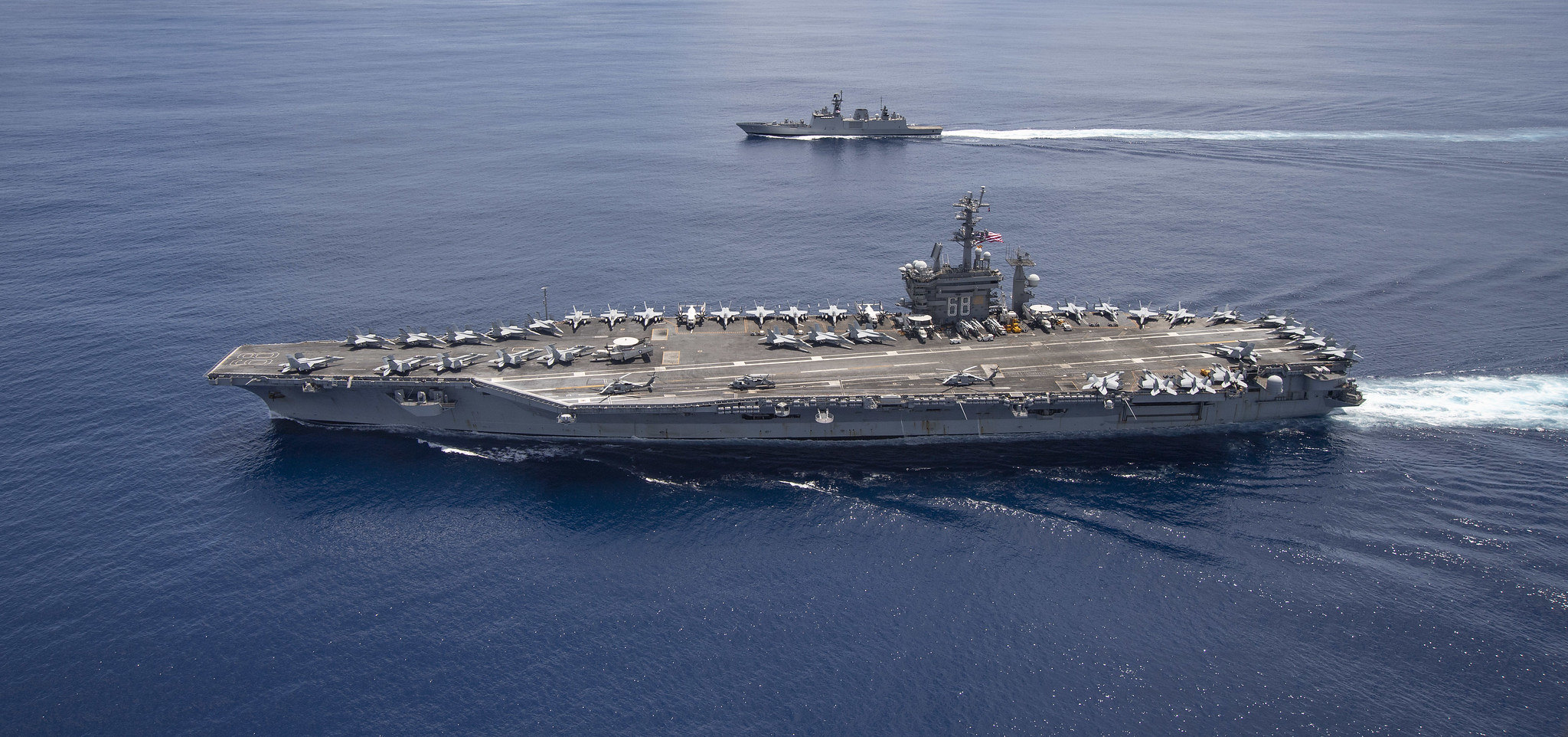
US aircraft carrier

United States

Within the US, militarised racist policing and immigration enforcement are responsible for severe human rights abuses. Externally, the US is engaged in multiple wars around the world, often alongside the UK.

Last updated 22 January 2026

The United States of America is the world’s sole military superpower. It is by far the world’s largest military spender and arms producer, and by some margin the largest arms exporter.

Externally, the US is engaged in multiple wars around the world, including most recently in Afghanistan, Iraq, Somalia, and Yemen, and has ongoing tensions, some severe, with numerous countries. Internally, increasingly militarised police forces are responsible for hundreds of killings every year, disproportionately of black and minority ethnic people, while Immigration and Customs Enforcement (ICE) and border control forces terrorise immigrant communities and are responsible for severe human rights abuses.

The UK is the US’s closest military ally, frequently participating in US-led wars. There is a substantial two-way arms trade between the two countries, and there is likewise a strong degree of integration between the two countries’ arms industries.

Militarised policing and border control

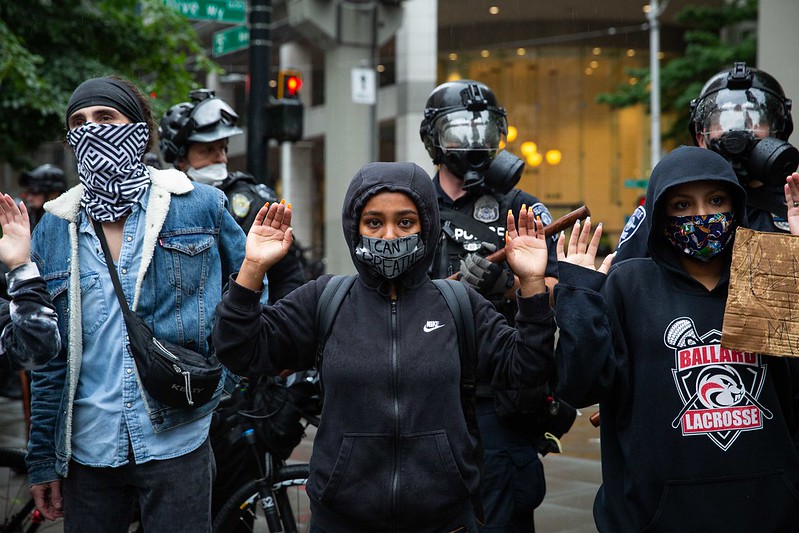
Protests in the US against violence by police and other US security services have been met with further state violence. For example, following the murder of George Floyd in May 2020, President Trump threatened to deploy the army against protestors and seek “total domination”.  Following widespread protests against abductions of immigrants and citizens by ICE in Minnesota in early 2026, he threatened to invoke the Insurrection Act, which would place allow him to deploy deploy federal military troops inside the country

Police forces in the US, as in the UK and many other countries, disproportionately target people and communities of colour for surveillance, arrest, and violence. US police killed at least 1,314 people in 2025, according to Mapping Police Violence.

Many US police forces have increasingly acquired military equipment through programs like the 1033 program that supply them with excess equipment from the armed forces. Such equipment includes armoured vehicles, aircraft, drones and helicopters, assault and sniper rifles, bayonets, grenade launchers, and body armour. Heavily armed police units have been used against protests by communities of colour, such as the Black Lives Matter movement and Native Americans at Standing Rock protesting the Keystone-X oil pipeline through their lands.

Meanwhile, the paramilitary Immigrations and Customs Enforcement organization (ICE) terrorizes immigrant communities with its increasingly frequent raids. ICE, along with Customs and Border Patrol (CBP) maintains a network of detention centres for undocumented immigrants, many of which keep detainees, including children, in extreme and inhumane conditions. In some of the detention camps at the borders, this includes keeping detainees in cages, with inadequate food, water, sanitation, medical care, and even protection from the elements.

The world’s dominant military power

Since the collapse of the Soviet Union in 1991, the US has been the world’s sole military superpower, with a huge lead over all possible rivals in capabilities, technology, and global reach.

In 2024, US military spending stood at US$ 997 billion, 37% of the global total, according to data from the Stockholm International Peace Research Institute (SIPRI). This was 3.1 times as high as the second biggest spender, China, and about equal to the sum of the next 10 highest spenders after the US.

The US likewise has by far the largest arms industry in the world. In 2024, five of the six largest arms companies in the world, as measured by total sales of military equipment and services, were all American: Lockheed Martin, RTX, Northrop Grumman, General Dynamics and Boeing. UK-based BAE Systems was the only other company to rank among the American giants, as the world’s third largest company.

Wars and threats of wars

The US has been continuously at war in numerous countries around the world since the attacks on the World Trade Centre and the Pentagon carried out by Al Qaeda on 11 September 2001. Initially dubbed a “Global War on Terror”, these wars have come to be seen as “forever wars” – unending conflicts against a shifting series of enemies

The US was been continuously at war in Afghanistan between 2001 and its calamitous withdrawal in 2021, following a complete Taliban takeover in the country. The US occupation of Iraq, which lasted from 2003 and 2021, left a horrific record of abuse, displacement and insecurity in its wake, particularly after the whirlwind rise of Islamic State and associated groups. The US is also engaged in military action in Iraq, Syria, Somalia, Yemen, and the Sahel region of west Africa, mostly through air strikes (including with drones), and/or special forces. Its covert operations also span other nations, including Kenya and the Philippines.

Tensions between the US and Iran are periodically high, especially since the US assassination of a senior Iranian general in Iraq early in 2020, and retaliatory missile strikes by Iran on a US military base in Iraq. More recently, the US carried out major bombing raids on Iranian nuclear facilities in June 2025, and President Trump has at various times threatened further attacks. The US maintains an extremely severe sanctions regime against Iran, and maintains huge military forces in the Gulf.

Significant military tensions also exist between the US and China over military dominance in the Western Pacific region. Both sides are engaged in an arms race as the US seeks to maintain its dominant regional position, while China seeks to challenge it. The 2026 bombing of Venezuela and US-orchestrated coup, along with President Trump’s threats to take over Greenland, a territory of a NATO ally, demonstrate that American military adventurism abroad is far from over.

The US-UK arms trade and industrial linkages

The US is both a major customer for UK arms and a major supplier of arms to the UK. The UK was the largest supplier of conventional weapons to the US, accounting for 18% of US’ total imports between 2020 and 2024.

The US made deals worth US$ 6.25 billion (around UK£ 4.66 billion) for Foreign Military Sales to the UK between 2020-24 (sales from government-to-government agreements). Between fiscal years 2022 and 2024, a further US$ 6.33 billion (around UK£ 4.72 billion) was delivered under Direct Commercial Sales licences, according to data held by CAAT.

However, links between the US and UK arms industries run much deeper than this. A Defence Cooperation Treaty signed in 2007 greatly eases arms sales between the two countries, so that specific licences are not required for most exports. The UK is a major partner in the US’s F-35 stealth fighter aircraft programme, with 15% of the value of each plane produced in the UK, while the UK is planning to buy 138 of the aircraft itself, of which it had acquired 37 by 2025.

Many major UK arms companies, including BAE Systems, Rolls Royce, QinetiQ, Cobham, and Meggitt, have substantial parts of their business located in the US, and several major US arms companies likewise have significant UK subsidiaries.

Related content

Black Lives Matter protest in Seattle, May 2020

FAQ – UK export approvals

Following the murder of George Floyd, protests in the US against racism and police violence have been met with further state violence. The response in the UK has included anger at the potential role of the UK in supplying equipment that could be used to suppress protests. Here we try to answer some of the

US aircraft carrier

U.S. Indo-Pacific Command,  CC BY-NC-ND 2.0

Forever wars

The US has been continuously at war in numerous countries around the world since the attacks on the World Trade Centre and the Pentagon carried out by Al Qaeda on 11 September 2001. Initially dubbed a “Global War on Terror”, these wars have come to be seen as “forever wars” – unending conflicts against a

Publication listing image placeholder

US arms exports

The United States is the world’s largest arms exporter, by any measure. The US was responsible for 43% of the exports of major conventional weapons worldwide between 2020-2024. Its share of global arms exports grew from 35 per cent in 2015-2019, according to the analysis by the Stockholm International Peace Research

Data

CAAT would not exist without its supporters. Each new supporter helps us strengthen our call for an end to the international arms trade.

Keep in touch