The US-UK arms trade

Last updated 22 January 2026


UK governments often like to boast of the UK’s “special relationship” with the US. How central this relationship really is to the US is debatable, but one area where cooperation between the two countries is particularly close is in the arms industry and trade. Each is a significant supplier of arms to the other, they are engaged in major collaborative arms programmes, most notably the F-35 Joint Strike Fighter programme, and the major UK arms companies have large subsidiaries in the US, and vice versa.

UK arms sales to the US

While the US sources most of its arms from US-based arms companies, it is also a significant importer, the 9th biggest worldwide between 2020 and 2024, according to SIPRI data for major conventional weapons transfers. The UK was the largest supplier of such weapons to the US, accounting for 18% of US’ total imports in that period. This makes the US the UK’s second largest arms customer after Qatar.

However, as a large proportion of UK arms trade in general consists of subsystems, components, and services, which not counted by SIPRI, this only tells part of the story. These figures are based on the value of arms contracts won by UK companies, collected by UK Defence and Security Exports. Figures for individual countries are not made public. Over the same period, the UK issued standard (Single Individual) export licences for arms sales to the US worth only UK£ 4.6 billion but the majority of UK arms sales to the US are made using the secretive open licencing system.

The UK-US Defence Cooperation Treaty in particular means that the process of gaining permission to sell arms between the two is greatly simplified and eased. In the UK, this takes the form of an Open General Export Licence (OGEL), for which companies can register, and which then, subject to certain conditions and record-keeping, allows them to sell a very wide range of military equipment, technology, and services to the US without the need for specific permits for each sale. Once a company is registered for this OGEL, this permission lasts indefinitely.
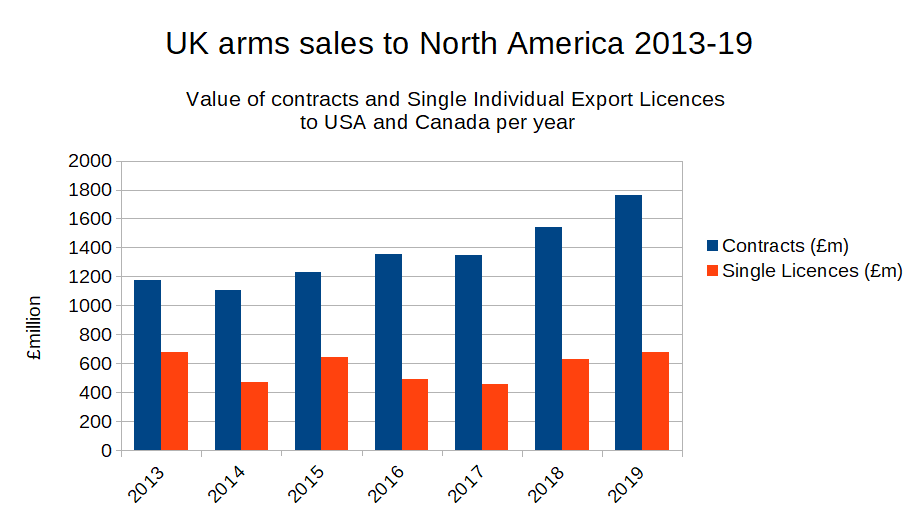

Bar chart showing UK arms sales to North America 2013-19


Anti-protest equipment sales to the US

One particularly concerning aspect of UK arms sales to the US is a wide range of anti-protest equipment, including tear gas, riot shields, batons, and other equipment of the type used by police to suppress protest movements in the UK, particularly the Black Lives Matter, Indigenous protests and anti-immigration raid protests. UK-supplied riot shields were used against Black Lives Matter protestors in 2020 by at least 6 law enforcement agencies. Following the murder of George Floyd in May 2020, protests in the US against racism and police violence have been met with further state violence. The response in the UK has included anger at the potential role of the UK in supplying equipment that could be used to suppress protests. Here we try to answer some of the key questions around those sales.

Black Lives Matter protest in Seattle, May 2020

FAQ – UK export approvals

Following the murder of George Floyd, protests in the US against racism and police violence have been met with further state violence. The response in the UK has included anger at the potential role of the UK in supplying equipment that could be used to suppress protests. Here we try to answer some of the

Black Lives Matter protest in Seattle, May 2020

Kelly Kine, CC BY-NC-ND 2.0

FAQ – UK ‘crowd control’ manufacturers

Following the murder of George Floyd, protests in the US against racism and police violence have been met with further state violence. The response in the UK has included anger at the potential role of the UK in supplying equipment that could be used to suppress protests. Here we try to answer some of the

US arms sales to the UK

From US fiscal years 2020 to 2024, the US made deals worth US$ 6.25 billion (around UK£ 4.66 billion) for Foreign Military Sales to the UK (sales from government-to-government agreements). Between fiscal years 2022 and 2024, a further US$ 6.33 billion (around UK£ 4.72 billion) was delivered under Direct Commercial Sales licences, according to data held by CAAT. The FMS figure reported by the US differs somewhat from the UK’s own accounting. According to UK government data, between fiscal years 2019 and 2024, the UK spent a total of UK£ 5.2 billion (in constant 2023-2024 prices) on FMS acquisitions.

Over 83% of this total was spent acquiring five major aircrafts from US companies via the US government: the Apache attack helicopter, C17 platform Globemaster transport craft, Chinook helicopter, and P8-A patrol and reconnaissance airplane, all Boeing aircraft; and various Uncrewed Aircraft Systems (UAS).

The UK has also bought many bombs and missiles from the US, including the Paveway IV guided bombs produced in the UK using US technology, which the UK also sells to Saudi Arabia.

Nuclear weapons

The UK is also highly dependent on the US for its “independent” nuclear deterrent. The Vanguard nuclear submarines that carry the UK’s Trident nuclear missiles are produced in the UK, as will be the Dreadnought submarines that will replace them at a build cost of over UK£ 41 billion. But the Trident missiles they carry are US-produced, by Lockheed Martin, and in fact are leased by the UK from a pool of missiles maintained by the US. The new warhead being designed for the UK’s nuclear weapons is also closely linked to a parallel US project, the US W93 Trident missile, and depends on US cooperation. This open arrangement of sharing of nuclear weapons equipment and technology is unique among the nuclear weapons powers.

The UK role in the F-35

The UK is the only national “Level 1 industrial partner,” besides the US, for the F-35 Joint Strike Fighter program, with around 15% of the value of each plane developed or produced in the UK mostly by BAE Systems, who hold a 13-15% workshare. As well as supplying the US, the UK, Japan, and other European air forces, the F-35 has been sold to Israel, who have so far made three orders totalling 75 planes, of which 45 had been delivered by mid-2025. The first two orders for 33 planes cost on average US$ 110 million each. In 2020, the US agreed a sale of 50 F-35s to the UAE for US$ 10.4 billion. In 2025, Lockheed Martin announced that it had sold 191 F-35 fighter jets in 2025. As the UK produces 15% of the value of each F-35 produced, this represents massive indirect arms sales by the UK to these countries.

UK sales of components and equipment for the F-35 are covered by a specific OGEL, which allows registered companies to conduct unlimited exports of F-35-related material to the US and most other F-35 customers, without specific licencing. This means that most F-35-related exports are not visible in the government’s regular export-licencing data.

Despite the vast expense of the F-35 programme, with a projected lifetime cost in 2025 of US$ 2.1 trillion for the US, the F-35 has been widely criticised for its poor performance,  to the point many analysts have described it as having “failed”. It has nonetheless been an enormous money spinner, primarily for Lockheed Martin and the US arms industry, but also for the UK arms industry, especially BAE Systems.

Key statistics

UK£ 5,200,000,000

US arms sales to the UK 2020-2024

source

UK£ 4,600,000,000

Value of UK military export licences to US

source

Intertwined industries

The US and UK arms industries are deeply interconnected: by trade between the two countries, by joint programmes like the F-35, and by corporate ownership, with major UK arms companies having large subsidiaries in the US, and (to a lesser degree) vice versa.

UK arms companies with subsidiaries in the US

BAE Systems has almost as much of their activities in the US as in the UK, especially in their military electronics systems, land systems, and cyber warfare and security businesses, which are controlled by a US subsidiary, BAE Systems Inc. According to the 2024 annual report of BAE Systems PLC, its UK branch, 44% of its sales were to the US, while 31,900 out of 89,600 of their employees were based in the US (36%).

Rolls Royce has 5,000 out of their total 50,000 employees in the US.

QinetiQ made 17.8% of its 2024 revenues (UK£ 338 million) from its US businesses, which specialise in robotics, autonomous systems, and sensing solutions.

Meggitt produces a variety of subsystems for military and civil aircraft, land and naval systems, and a variety of other military and civil technology. Despite being founded and headquartered in the UK, most their employees in 2019-20 were in North America, 4,871 out of 9,280, or 52%. In particular, 74% of their military revenues in 2019-20 were from US customers.

Cobham produce military electronics systems, communication and connectivity systems, and military aerospace mission systems. Their Advanced Electronics Systems and much of their Mission Systems business is based in the US. In total, 52% of their employees in 2018 were based in the US, despite the company being headquartered in the UK. Cobham were taken over by Advent International, a US private equity company, in January 2020.

US arms companies with subsidiaries in the UK

RTX, formerly Raytheon Technologies, the world’s largest arms companies, has a UK subsidiary, Raytheon UK Ltd. It has 30 UK sites employing over 35,000 people, over 80% of which are in England. Raytheon UK’s business includes airborne intelligence, surveillance and reconnaissance, cyber and intelligence, sensors, missiles and bombs, and military training systems. The Raytheon factory in Glenrothes, Scotland, produces Paveway IV bombs which are both used by the UK military, and are sold to Saudi Arabia, where they have regularly been used in the war in Yemen.

Lockheed Martin, the world’s largest arms company, employs 20,000 people in the UK.

General Dynamics have 1,500 UK employees in their UK subsidiary, of which 900 are in Wales. GDUK produce military vehicles, as well as avionics and military communications systems.

CAAT would not exist without its supporters. Each new supporter helps us strengthen our call for an end to the international arms trade.

Keep in touch