
The United States remains the world’s overwhelmingly dominant military power. In a world where international relations still too often follow a logic of militarism and power competition, the US sits at the apex, asserting a right and duty to project military power in every region of the globe, and to use it to go to war wherever it sees its interests as threatened.
Military spending
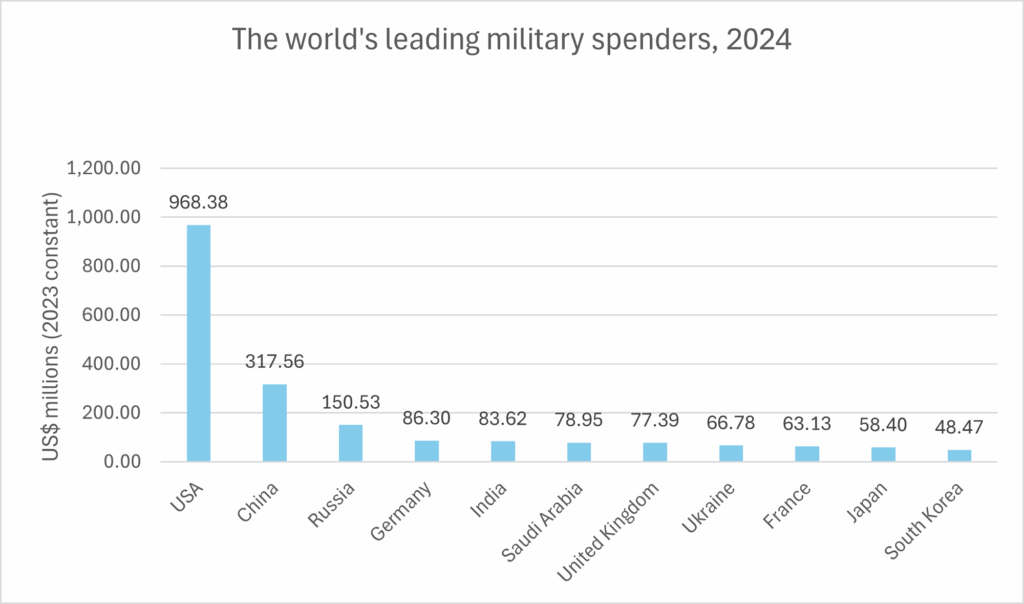
The US has by far the world’s highest level of military spending. In 2024, US military spending totalled US$ 968.38 billion, according to Stockholm international Peace Research Institute (SIPRI) military expenditure data. This was over 3 times as much as its nearest rival China (US$ 317.56 billion), and more than the ten next biggest spenders combined. Some analysts note that this does not cover the full cost of US military forces and activities, as it does not include interest on the national debt or most spending to support veterans of past wars, making the real total likely much higher.
The military industrial congressional complex
The gigantic US military budget means that in particular it is the world’s biggest buyer of arms – mostly from its own domestic industry, the largest in the world by far, although it also imports arms, including from the UK. The US Department of Defense (DOD) had a 2024 budget of US$ 1.4 trillion, a significant amount of which was spent on procurement equipment and services, mostly from the arms industry. [NB: Sam – this data is spread across dozens of categories in the data source so I haven’t been able to tabulate it]. The F-35 stealth combat aircraft is the most expensive weapons programme in history, and is expected to cost US$ 2 trillion over the plane’s 50 year lifespan.
Like in the UK, the DOD, members of Congress, and the arms industry share an interest in expanding the arms budget with ever larger, more complex, and more expensive programmes, frequently involving massive waste and inefficiency, and doing little or nothing for the real security needs of the American people. Like in the UK, a revolving door between the DOD and industry encourages DOD officials and top military officers to prioritise the interests of the arms industry, while large campaign contributions and lobbying expenditure, as well as the promise of jobs in their electoral district, encourage Senators and Congressional Representatives to do the same. As a result, the bloated Pentagon budget is rarely questioned by more than a small minority of politicians. While Republicans and Democrats are opposed in almost all areas, leading to gridlock in most areas of Congressional legislation, in July 2025, the US House of Representatives passed a defense bill for fiscal year 2026 containing a total a total discretionary allocation of US$ 831.5 billion. This discretionary allocation is supplemented by a further US$ 150 billion in defense mandatory spending in President Trump’s “One Big Beautiful Bill” which will take the total defense budget to just under US$ 1 trillion.
This highly corrupt, but legal system of influence and favours that maintains such obscenely high spending on arms is sometimes called the Military Industrial Congressional Complex.
The US arms industry
The US is home to the world’s top 5 arms companies, according to data from SIPRI. These companies had combined revenues from military sales of $ 198.34 billion in 2024. The top 5 companies in 2019 were:
- Lockheed Martin, with arms revenues of US$ 60.8 billion in 2019. Lockheed are the manufacturers of the F-35, as well as the F-16 fighter used by dozens of air forces around the world. They also own combat helicopter manufacturer Sikorsky.
- RTX, formerly Raytheon, with arms sales of US$ 40.66 billion in 2024, are the world’s biggest manufacturers of missiles, as well as a range of other high-tech weaponry and systems.
- Northrop Grumman, with arms sales of US$ 35.57 billion in 2024. The company produces a range of systems for land, sea, air, and cyberspace.
- Boeing, with arms sales of $31.1 billion in 2024. Boeing manufacture the F-15 and F/A-18 fighters, as well as transport aircraft, satellites, and much more.
- General Dynamics, with arms sales of US$ 30.2 billion in 2024, produce tanks, armoured vehicles, artillery, and other land systems, and submarines and surface warships, including submarines carrying nuclear weapons.
These are just the largest of hundreds of other US arms companies, which include some of the leading military technology and services companies in the world. Many major UK companies also have large US subsidiaries, most notably BAE Systems.
The main customer for US arms companies is the US Department of Defense. But these companies also sell their arms around the world, fuelling war and repression, in conjunction with the US government.