Who does the US sell to?
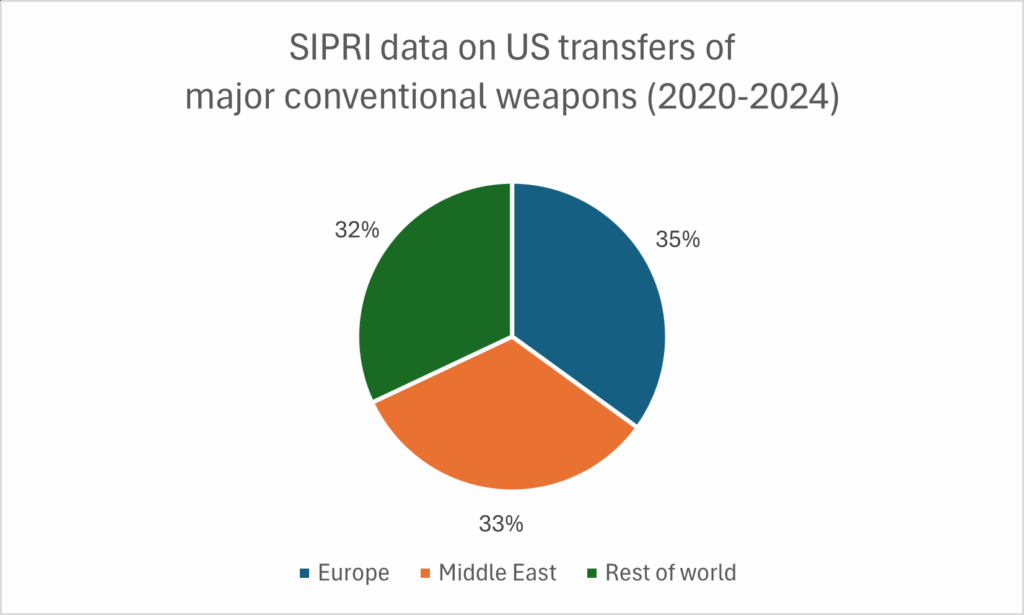
The US sells arms to most countries worldwide. Between 2020 and 2024, according to SIPRI data, the US transferred major conventional weapons to 107 states, as well as to NATO and the United Nations.
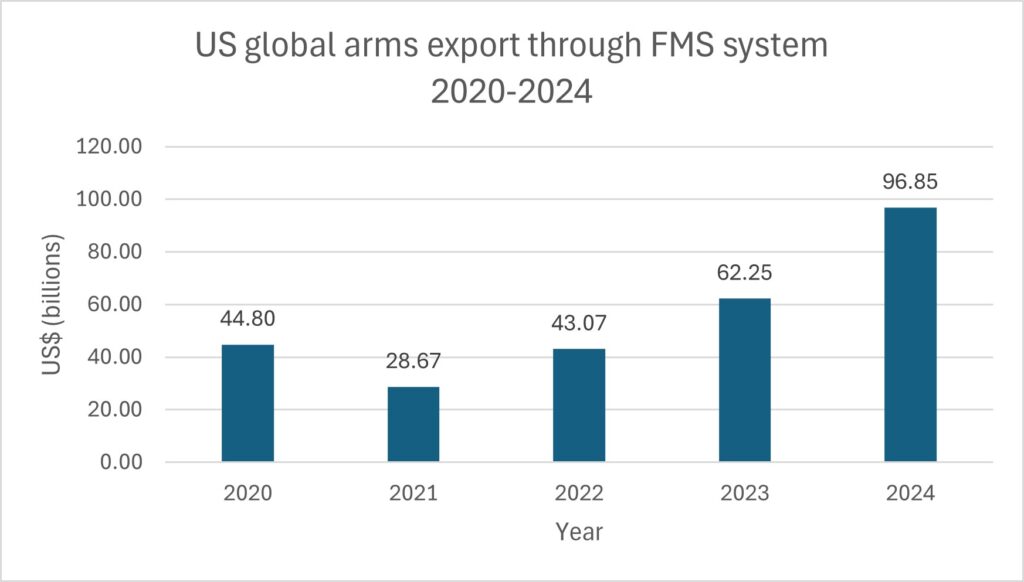
Based on Foreign Military Sales data, which includes equipment not counted as major conventional weapons by SIPRI, the US agreed sales of at least US$ 1 million worth of arms with 122 states in the same period. Some countries however are particularly major customers, and some raise severe concerns over conflict and human rights.
Saudi Arabia
The US is the leading supplier of arms to Saudi Arabia. According to SIPRI, the US supplied 74% of the country’s major conventional weapons between 2020 and 2024. This accounted for 12% of all US arms sales in that period, making Saudi Arabia the US’ largest customer. According to the Defense Security Cooperation Agency, the US agreed nearly US$ 7.616 billion worth of FMS arms sales with Saudi Arabia between 2020 and 2024.
Around half the Saudi Air Force is US-made (the other half being from the UK), and like the UK, the US provides constant maintenance, support, training, logistics, and services for the planes they supply, without which Saudi Arabia could not keep them flying. This has continued throughout the war in Yemen, as has the supply of the precision-guided munitions and missiles dropped on Yemen. In those cases where weapons fragments have been identified from Saudi coalition air attacks on civilians in Yemen, the majority have been US-made.
Major recent arms sales to Saudi Arabia (with deliveries 2015 or later) include:
- a 2011 order for 152 F-15 Advanced Eagle fighter/ground attack aircraft, as part of a US$ 29 billion deal. 91 of these have been delivered, all during the war on Yemen
- 24 Patriot anti-missile systems ordered in 2011 and 2015, and delivered 2014-19, for a total of US$ 3.7 billion
- 7 THAAD anti-missile systems ordered in 2018 as part of a US$ 15 billion deal
- 48 combat helicopters and 84 other helicopters
- 153 tanks, 4 frigates, 2 tanker/transport aircraft, and a host of missiles, radars, combat systems, and other associated equipment.
The administration of US President Joe Biden pledged in 2021 to end support for “offensive operations” in the war in Yemen, and suspended arms sales pending a review. However, then-President Biden also said it would continue to support Saudi Arabia’s “defence” needs. Administration officials indicated in 2021 that it was only the sale of bombs and air-to-surface missiles that would be cancelled, with other planned sales going ahead. In 2022, the administration was weighing resuming sales more generally, and it began rearming Saudi Arabia with “offensive” weapons in August 2024.
US President Trump, upon taking office in January 2025, quickly moved to secure a further huge arms sale worth US$ 142 billion with Saudi Arabia, which the administration stated in May 2025 was the “largest defence sales agreement in history.”
The United Arab Emirates and other Gulf states
As with Saudi Arabia, the US is a strong supporter of the absolute monarchic regimes of the Gulf, all of which are serious human rights abusers, and most of which have been involved in the war in Yemen. The UAE is also deeply involved in conflicts in Libya and Syria and elsewhere, and has diverted weapons to a variety of armed groups. Meanwhile in Bahrain, US arms supplies are used to prop up a brutal dictatorship that treats its Shia minority as second-class citizens.
According to the Defense Security Cooperation Agency, between fiscal years 2020-2024, the US agreed FMS deals worth US$ 1.21 billion with Bahrain, US$ 9.11 billion with Kuwait, US$ 675 million with Qatar, and US$ 4.807 billion with UAE. Moreover, in the dying months of the first Trump presidential administration, the US provisionally agreed a US$ 23 billion package of arms sales to UAE, including F-35 stealth fighter aircraft. Despite holding a review, the administration of US President Biden decided in April 2021 to proceed with these sales. President Trump’s second administration, which began in January 2025, has seen several significant American arms sales to these countries, profiled on their country pages. These countries, together with Oman, accounted for 17.3% of transfers of major conventional weaponry by the US between 2020 and 2024, according to SIPRI data.
Israel
The US is Israel’s largest foreign arms supplier by far, providing the great majority of the country’s arms, apart from those it produces itself. Germany is Israel’s second largest foreign supplier of arms, including a significant supplier of major conventional weapons to Israel, especially submarines. All of the combat aircraft used by Israel in its numerous wars on Gaza are US-made, as is a large proportion of the munitions fired by them. Israel has large numbers of US F-15 and F-16 aircraft, and has started to receive F-35 stealth fighters as well. Between fiscal years 2020 and 2024, the US agreed US$ 14.2 billion in FMS arms sales with Israel, with a large spike in sales following Israel’s 2023 Gaza offensive. Three percent of the US’ total deliveries of major conventional weapons in this period were to Israel, according to SIPRI data.
Most, if not all, of Israel’s arms imports from the US are paid for with the US$ 3.8 billion a year in military aid provided by the US. This military aid arrangement, which has increased substantially in recent years, started in a major way following the 6-day war in 1968. Since the Hamas attacks of October 7 2023 and the start of Israel’s genocidal war on Gaza, this aid has surged to even higher levels: according to Brown University’s Costs of War project, in the first two years of the war, the US spend a total of US$ 21.7 billion in military aid to Israel. US military support for Israel has traditionally enjoyed strong support among both Republican and Democrat politicians. However, American public approval for Israel, particularly among Democratic and younger voters, has declined sharply according to 2025 surveys, due to Israel’s genocide in Gaza. A New York Times/Sienna poll in September 2025 found that a majority of voters opposed providing further military or economic aid to Israel, while voters were roughly evenly split on whether they sympathised more with Israel or the Palestinians.
Ukraine
After Saudi Arabia, Ukraine is the US biggest arms market. It received 9% of all US conventional arms transfers between 2020 and 2024, according to SIPRI. The US is a close military ally of Ukraine and has been heavily involved in its political development since its independence from the USSR. Ukraine has benefitted from large-scale transfers of US equipment, with American companies profiting handsomely. Between 2020 and 2024, the US made US$ 1.21 billion in foreign military sales to Ukraine, according to US government data, well over half of total FMS sales to the country since 1950. Over half of the US Department of Defense’s 2024 supplemental spending, which totalled US$ 72.8 billion, was earmarked to fund financial aid, equipment and training for the Ukrainian military (US$ 48.4 billion), outranking even contributions to Israel.
Significant arms contributions in 2025 alone include: the Raytheon PATRIOT air defense system for US$ 105 million, a Starlink satellite communicatons system for US$ 150 million, US$ 825 million worth of missiles from Zone 5 Technologies and CoAspire, updgrades to its BAE Systems M777 Howitzers worth US$ 104 million, and a Raytheon HAWK Phase III Missile System worth US$ 172 million. Older acquisitions include 55 helicopters from Airbus (2018), General Dynamics Hydra-70 Rocket Systems (2023), and Teledyne Skyranger UAVs (2024). Ukraine also operates a fleet of Lockheed Martin F-16 fighter jets and Lockheed Martin ATACMS missiles.
Egypt
Egypt also receives regular US military aid, to the tune of US$ 1.3 billion a year. This began after the Camp David peace agreement between Egypt and Israel in 1978, essentially as a reward for agreeing and keeping to the treaty. It has continued ever since, long after its original purpose has become moot, with the two countries maintaining a close relationship regardless of US inducements. The US agreed US$ 6.12 billion in FMS deals with Egypt between 2020 and 2024, and delivered major conventional weapons accounting for 1.4% of US exports in this period. While the Obama administration briefly suspended arms sales in the wake of the military coup in 2013 and subsequent massacres of protesters, they were resumed soon afterwards in spite of the extreme brutality of the dictatorship against political opposition, as well as in its military campaign against rebels in the Sinai region. In 2018, the Trump administration released US$ 195 million in military aid to Egypt that was previously withheld over human rights concerns. Egypt’s prime position as a military ally is reflected in the exemption of Israel and Egypt both from the Trump administration’s 2025 halt to virtually all foreign aid. This is not without its strings: in March 2025, the administration informed Egypt it planned to make future aid contingent on Egypt accepting Palestinians displaced by Israel’s genocide in the Gaza strip.
Afghanistan and Iraq
The US has been a major suppliers of arms to the Afghan and Iraqi governments for the past 25 years, since the 9/11 terrorist attacks in the US and its second Gulf war. The US has sought to build up both nations’ military strength and help them fight armed groups such as the Taliban, Al Qaeda, Islamic State and their various affiliates and offshoots. This has gone disastrously in both countries. In Afghanistan, August 2021 saw a complete Taliban takeover of the territory and government, and the near complete withdrawal of US military presence in the country. In Iraq, the US-led coalition officially concluded its combat mission in December 2021, but it maintains a small group of troops in country.
US arms supplies have been accompanied by substantial military aid. As well as enabling widespread human rights abuses and killing of civilians, US military assistance has been the subject of massive corruption and the diversion of arms to the enemies they were supposed to be fighting. Afghan security forces have never become an effective fighting force and the future of the Afghan government following US withdrawal and Taliban takeover in 2021 looks very uncertain. The Iraqi army collapsed in 2014 in the face of Islamic State advances, in large part the result of wholesale corruption which had left troops without basic equipment despite the vast aid pouring into the country. The US has consistently relied on a military-first approach to dealing with the conflicts in these countries that have resulted from or been exacerbated by the US invasions, supporting security forces regardless of their records on human rights and corruption, with devastating consequences. Between 2020 and 2024, Iraq and Afghanistan accounted for 0.1% and 0.5% of US major conventional weapon deliveries respectively, while new FMS agreements worth US$ 2.5 billion to Iraq were signed. Afghanistan’s FMS balance in that period was a negative amount, US$ -5 million, which indicates “an adjustment to one or more of previously implemented cases.”
Asia Pacific allies
A large proportion of US arms sales are with key allies in the Asia Pacific region as part of a strategy of countering Chinese military power. Thus, Australia, Japan, South Korea, and Taiwan accounted for 6.7%, 8.8%, 5.3% and 1.5%, respectively, of US deliveries of major conventional weapons from 2020 to 2024, according to SIPRI data. The value of new FMS agreements signed with these countries in the same period was US$23.3 billion, US$ 22.46 billion, US$ 13.01 billion, and US$ 22.24 billion respectively. Sales of F-35 stealth fighters to Australia, Japan, and South Korea have been among the biggest deals in recent years. These arms sales contribute to a growing arms race in the region between China on the one hand, and the US and many of China’s neighbours on the other. In December 2025, the US administration approved a US$ 11 billion military package to Taiwan, the country’s largest ever, which would include advanced rocket launchers, self-propelled howitzers and missiles. One month earlier, it approved a US$ 82 million package for Japan including guided and general purpose bombs and guidance kits, and a rumoured US$ 25 billion in arms for South Korea.
NATO members
According to SIPRI data, 26.5% of US major conventional weapons transfers between 2020 and 2024 were to fellow-NATO members, many of whom have joined the US in some or all of its recent wars. This increased from 15% on the previous four years, which is likely a reflection of the 2022 Russian invasion of Ukraine and ensuing conflict.
The largest of the 32 NATO recipients in this period was the UK, with 4.9% of all US exports over the period, followed by the Netherlands with 4.1%, Norway with 3.3%, Poland (2.5%), Italy (2.4%), Denmark (1.6%), and Germany (1.2%), according to SIPRI data.
Department of Defense Foreign Military Sales data gives a slightly different picture. The US agreed US$ 141.12 billion worth of FMS agreements with the 32 NATO members between 2020 and 2024. Top recipients were Poland (US$ 29.05 billion), Turkey (US$ 21.67 billion), Germany (US$ 17.36 billion). The UK ranked 8th among the 32 members, with US$ 6.2 billion. As with US allies in the Asia Pacific, sales of F-35 stealth combat aircraft have been among the largest recent deals to numerous NATO members, including the UK.
The Philippines
Within the Asia Pacific region, the Philippines is a relatively minor customer for US arms, but one raising significant concerns. The US agreed US$ 483 million worth of Foreign Military Sales to the country between 2020 and 2024. One major deal in this period was the sale of 15 Lockheed Martin Black Hawk attack helicopters to the Philippines, which were delivered in 2024. In 2025, the US agreed a sale of 20 F-35 fighter jets and F-16 fighter jets. The Philippines armed forces have also received substantial quantities of small arms from the US. Under its far-right President Rodrigo Duterte, who served from 2016 to 2022, the Philippines’ security forces were engaged in widespread extra-judicial killings of citizens, supposedly as part of a “war on drugs”, while the armed forces have been fighting a brutal counter-insurgency campaign in Mindanao, which has displaced over 450,000 civilians. In March 2025, Duterte was arrested by Philippine authorities acting on an arrest warrant issued by the International Criminal Court, where he was in custody in 2025. His successor, President Ferdinand “Bongbong” Marcos, was elected in 2022; Human Rights Watch reports that abuses such as “drug war” killings have persisted amid government vows to investigate and prosecute extrajudicial killings.
Colombia
The US has long been a major supplier of arms, military aid, and military training to Colombia, throughout most of its decades-long civil war. Despite the signing of a 2016 peace agreement between the Colombian government and the main rebel group, FARC, the country has continued to be plagued by violence, involving state forces, other rebel groups, drug cartels, far right-wing militias, and others. Journalists and environmental and labour activists have frequently been targeted for attack. The current right-wing government of President Iván Duque has been accused on going back on aspects of the peace deal, and supporting or turning a blind eye to attacks on former rebels, now disarmed and supposedly reintegrated into society. The Colombian armed forces have long been responsible for serious human rights abuses and attacks on civilians – most notoriously, during the 2000s, of “false positive” killings, where civilians were killed and then claimed to be rebels, to improve units’ figures. Abuses have continued since the peace agreement, and have been consistently enabled by US arms and military aid. The US agreed US$ 300.4 million in FMS arms deals to Colombia between 2020 and 2024; in 2024, the US provided US$ 377 million in foreign assistance, among which was US$37 million in Foreign Military Financing. Between fiscal years 2020 and 2024, the US State Department also provided US$ 8.69 million in International Military Education and Training (IMET) funding to the country.
Nigeria
The US agreed FMS contracts worth US$ 997 million with Nigeria between 2020 and 2024. Approved sales in this period included the August 2025 approved sale of munitions, bombs and rockets worth US$ 346 million; these would include the General Dynamics MK-82 and Lockheed Martin Paveway II GBU-12, among others. In 2022, the US government approved the sale of Bell Textron Inc AH-1Z Attack Helicopters, General Electric T-700 GE 401C engines, and two thousand BAE Systems Advanced Precision Kill Weapon System (APKWS) guidance sections, among other equipment.
Previous large contracts included the November 2018 sale, for the US$ 329 million of A-29 Super Tucano trainer/ground attack aircraft to support the Nigerian military’s fight against Boko Haram, Islamic State, and other armed groups. The Super Tucano is a Brazilian-designed plane, produced under licence by the Sierra Nevada Corporation in Colorado. This was approved despite severe concerns over the Nigerian military’s extensive human rights abuses, including the 2017 bombing of a refugee camp. More recently, the Nigerian military launched helicopter attacks on several villages, killing numerous civilians. The extreme level of corruption in the Nigerian military is a further concern. Nigeria received its first 6 Super Tucanos in March 2021.